
Our picks for AI Erotic Story Writer
Full reviews ↓ Joi AI4.9Try →Keeps characters and history straight across sessions — the thing chapters depend on.#2 · Most controllable voice
 Lovescape4.7Try →Fine control over tone and heat, so a register holds from one chapter to the next.#3 · Best illustrated drafts
 OurDream4.4Try →Pairs scenes with generated images if your project needs the visual side.
| # | Tool | Best for | Rating | From* | Link | |
|---|---|---|---|---|---|---|
| 1 | Joi AI | Visit | Best for long-form · ★ 4.9 · From ~$5/mo | ★ 4.9 | From ~$5/mo | Visit |
| 2 | Lovescape | Visit | Most controllable voice · ★ 4.7 · From $7.99/mo | ★ 4.7 | From $7.99/mo | Visit |
| 3 | OurDream | Visit | Best illustrated drafts · ★ 4.4 · From ~$9.99/mo | ★ 4.4 | From ~$9.99/mo | Visit |
| 4 |  Nectar AI | Visit | Best literary pacing · ★ 4.3 · From ~$5/mo | ★ 4.3 | From ~$5/mo | Visit |
| 5 |  Candy AI | Visit | Fastest drafting · ★ 4.5 · From $3.99/mo | ★ 4.5 | From $3.99/mo | Visit |
*Effective monthly price on the annual plan, checked September 2026; month-to-month billing costs more, and images or video use extra credits. Affiliate links — we may earn a commission. Order is from our own testing, not payouts.
Key takeaways
- Joi AI is our #1 AI erotic story writer for long-form work because it holds characters and their history across sessions better than the other four we ranked.
- Lovescape is the pick when each chapter needs a different register; Nectar AI writes the best slow-burn middle but needs re-briefing around chapter six.
- Most tools return 350 to 900 words per scene request, so a 2,000-word chapter is three or four generations, not one.
- My last novella took 26,400 raw AI words and about 38 hours to land at 19,800 words, with 23 of those hours spent editing.
- Nobody has solved book-length memory: paste a story bible into every scene prompt and run a continuity audit every four chapters.
Which AI erotic story writer should you use?
The best AI erotic story writer for chapters rather than snippets is Joi AI, because it keeps characters and their history straight across sessions better than anything else I have drafted with. If you care more about controlling tone and heat scene by scene, Lovescape is the close second.
I have edited AI drafts for a living since 2023, and every tool I use writes a competent 900-word scene in two minutes. Ask for chapter eleven of the novella that scene belongs to and you get a stranger writing about people who share your characters’ names. What breaks is memory: early chapters fade, both leads drift into one voice, and every scene resolves too early.
So this guide ranks tools on one question, whether they can carry a book, then gives you the method I use to get twenty thousand coherent words out of them. If you are still deciding what kind of tool you want at all, our erotic AI guide maps the formats first.
The best AI erotic story writer tools in 2026
Every tool below is ranked on suitability for long-form drafting: memory across sessions, voice consistency from chapter one to chapter twelve, and how many usable words each request returns.
Joi AI
Voice and emotional continuity across sessions
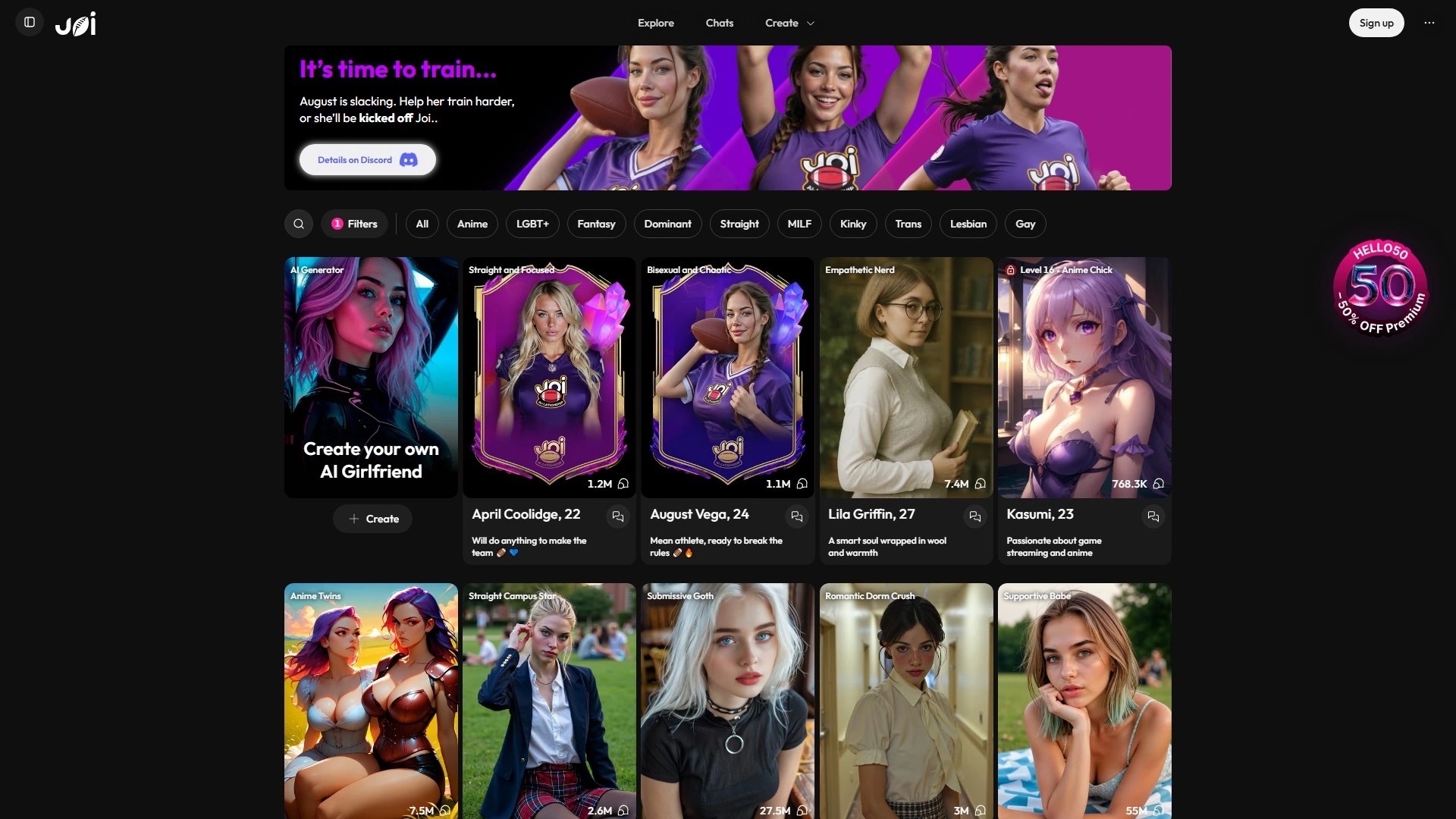
Strongest on tone that carries between sessions — a character that was hurt yesterday is still cool with you today. Voice output is the best of the group. The trade is shallower control over how a scene is described, and images and video cost extra in-app credits.
- Strong emotional continuity
- Voice-first interactions
- Rich character roster
- Higher subscription cost
- Less scene customization
- Less spicy by default
Lovescape
Custom characters and uncensored scene control
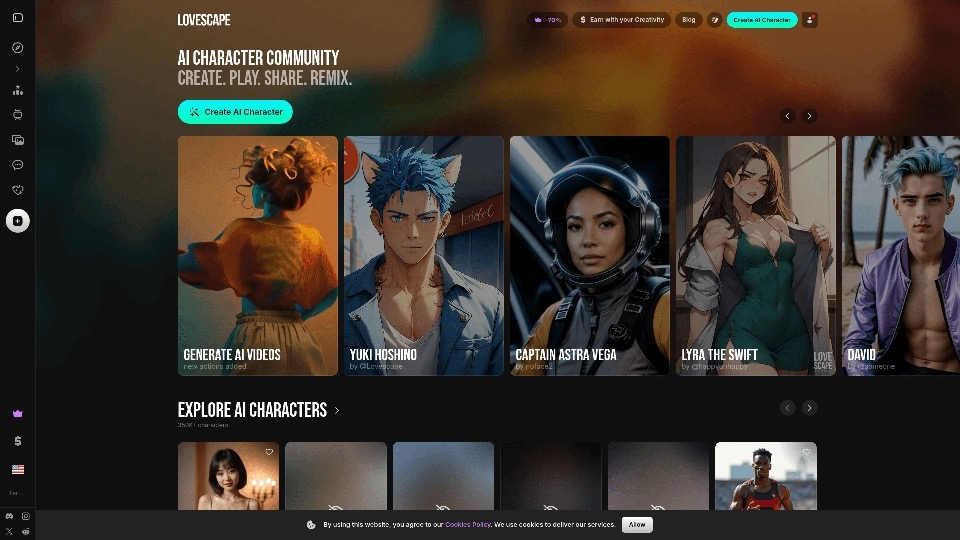
The most granular of the six on character setup: looks, temperament, relationship and the explicitness of the writing are all separate dials rather than one preset. It takes longer to start than the others, and the payoff is that scenes stop reading like a template after the first week.
- Instant scene customization
- Spicy uncensored writing
- Slick roleplay interface
- Slight learning curve
- Premium pricing
OurDream
Illustrated scenes and fast setup
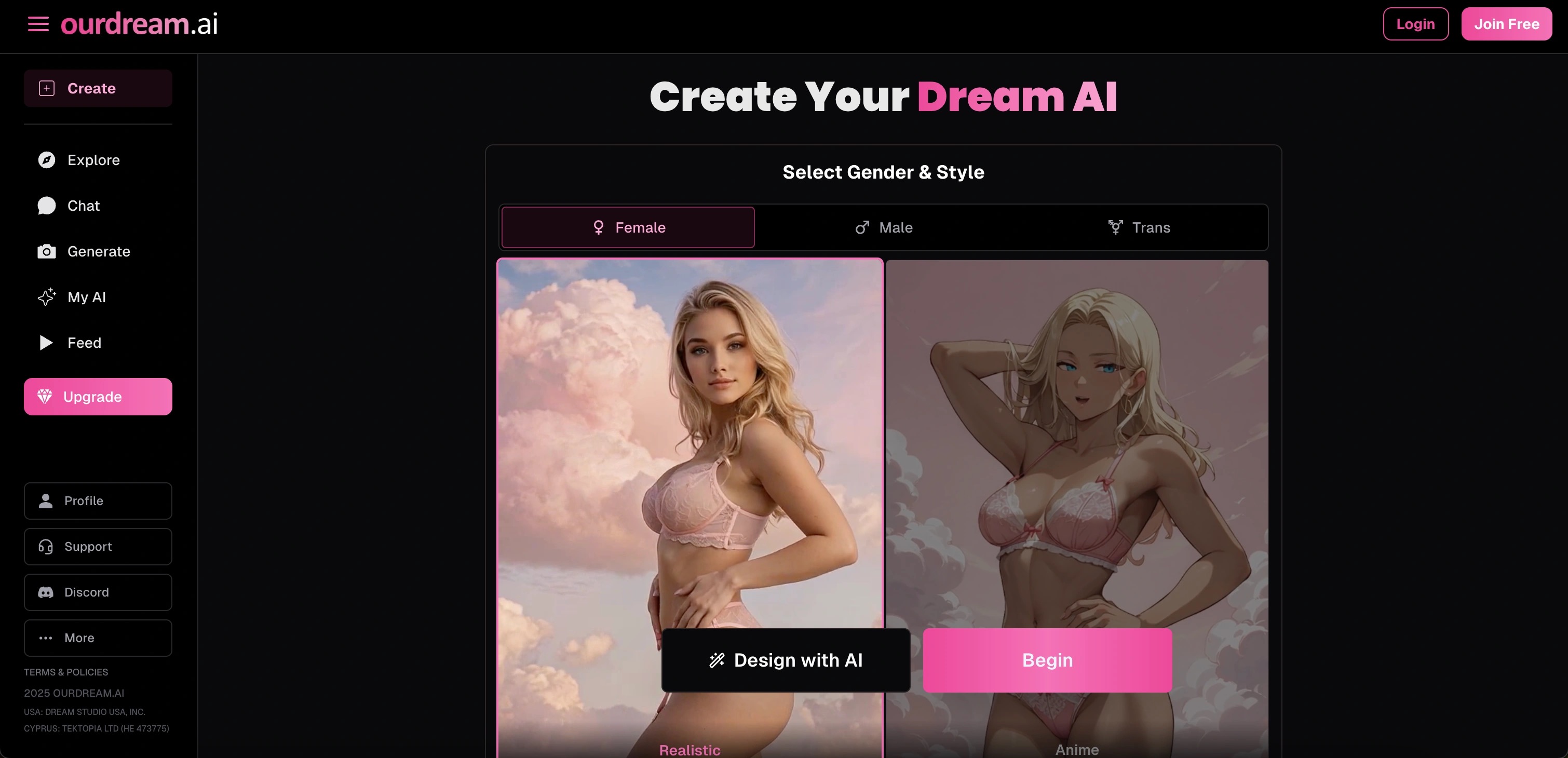
Built around visuals — realistic or anime — with image and video generation baked into the chat, and the fastest of the six to get from sign-up to a first scene. Text roleplay is the shallowest here, so it suits readers who want the picture as much as the paragraph.
- Anime-style presentation
- Built-in image generation
- Fast account setup
- Shallower text roleplay
- Less narrative depth
- Narrower fantasy range
Nectar AI
Slow-burn romance and restrained prose
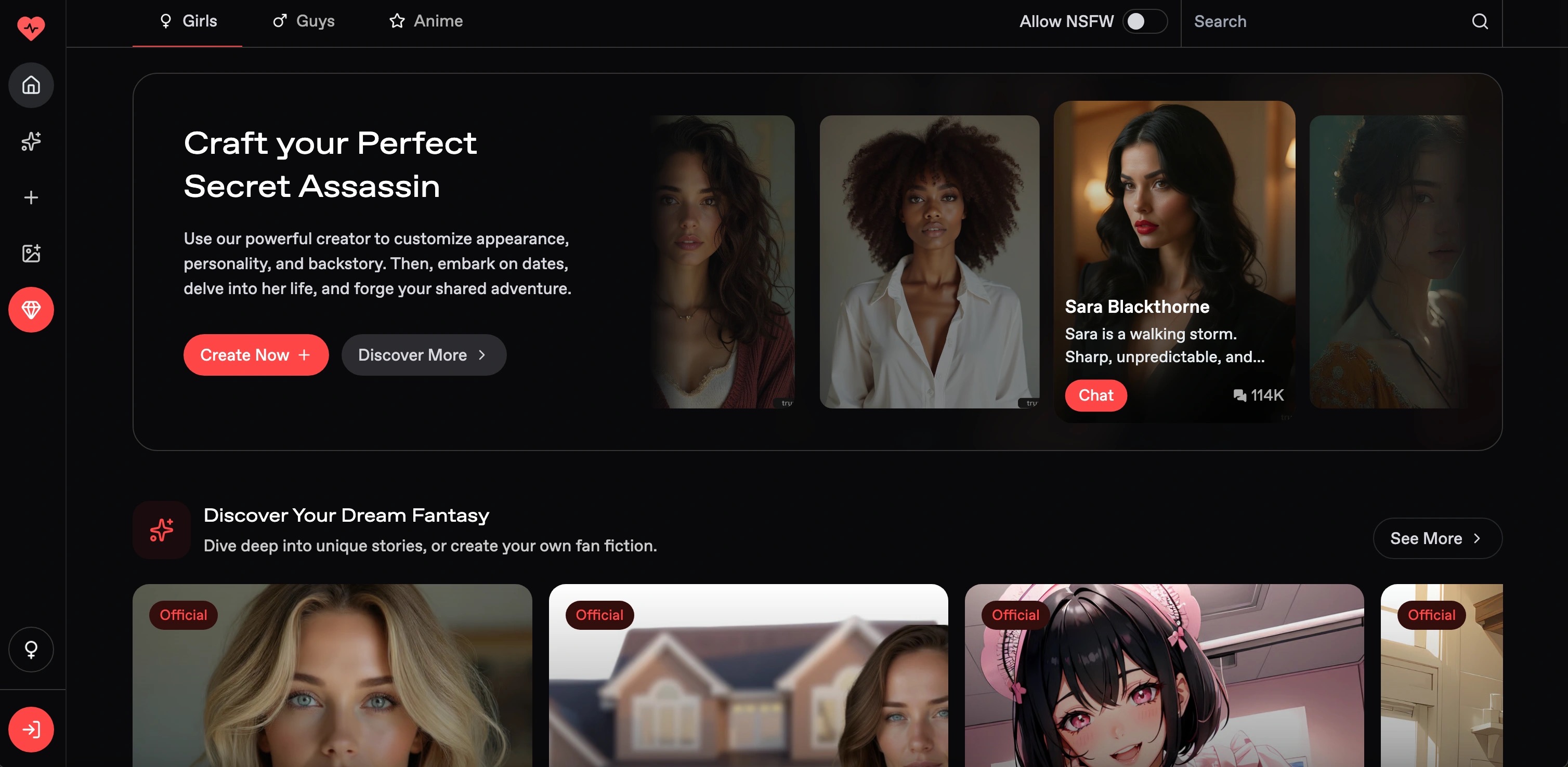
Writes closest to published romance — it will stretch the approach across several exchanges instead of jumping to the payoff. If you want the payoff immediately, this is the wrong tool and the pacing will frustrate you.
- Romantic fiction tone
- Slow-burn storytelling
- Strong emotional pacing
- Smaller character roster
- Less instant spice
- Fewer customization options
Candy AI
Breadth of characters and fast replies
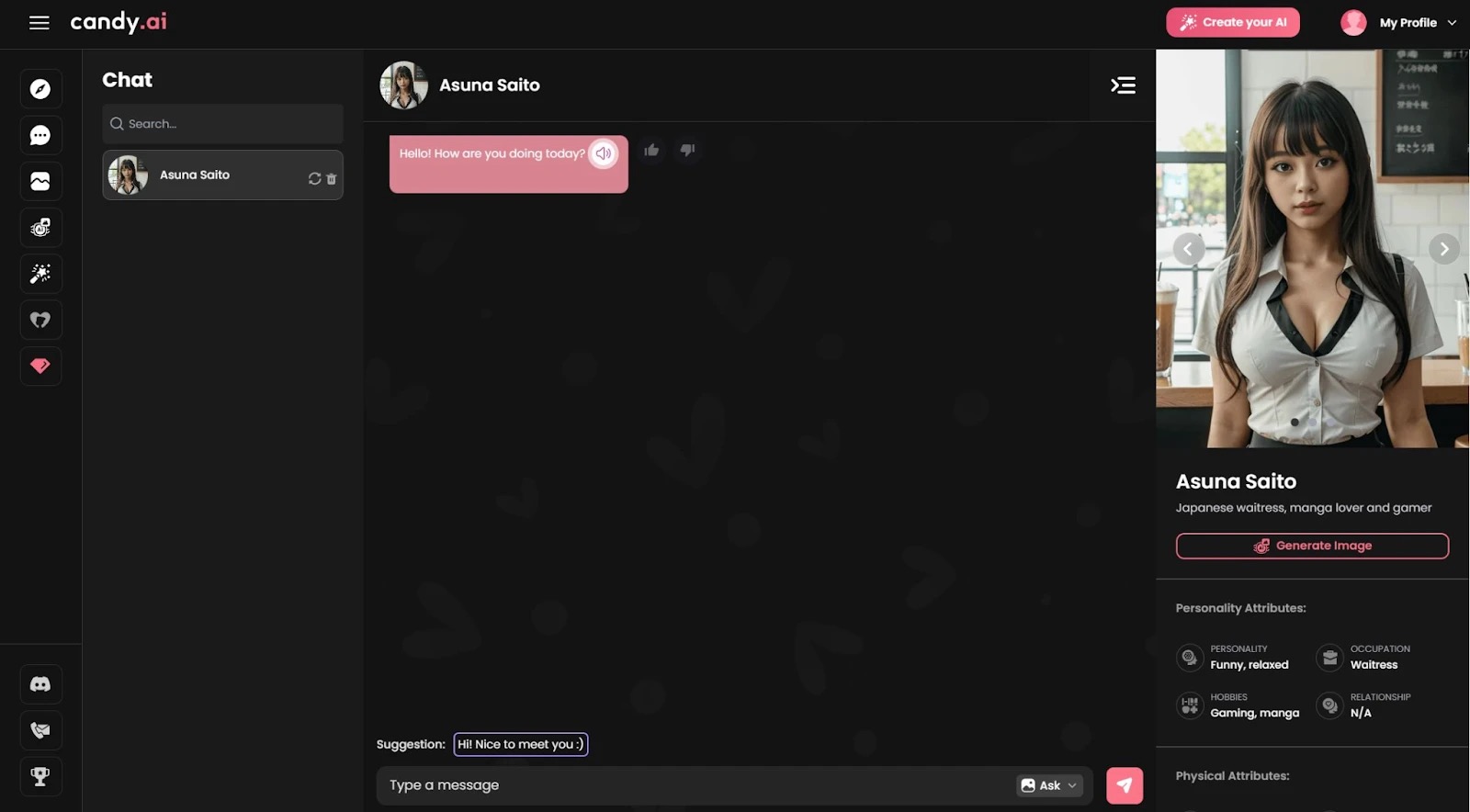
The biggest roster and the quickest replies, with a mobile app that actually works. Long-term memory is the weak point: hold a storyline for a few weeks and you will be reminding it of its own backstory.
- Huge character library
- Polished mobile app
- Fast response speed
- Weaker long-term memory
- Less custom story control
- More generic scenes
1. Joi AI — Best for long-form
In Joi AI, a character hurt in yesterday’s session is still cool with you today, and that continuity is what falls apart elsewhere by chapter four. It returns 450 to 700 words per scene request, the longest typical reply of the five, and it holds tone across sessions better than anything else listed. The trade is shallower control over how a scene is described, and images or video cost extra “Neurons” on top of the subscription. For a twelve-chapter project where the through-line matters most, start your draft on Joi AI and keep your story bible beside it anyway.
2. Lovescape — Most controllable voice
Lovescape treats looks, temperament, relationship and explicitness as separate dials instead of one preset, which is what you want when chapter four needs a different register from chapter eight. Voice consistency is very good, and memory is good provided the character sheet carries the facts, so paste your cast section in rather than trusting it to recall. Output runs 400 to 650 words per request. Setup takes longer than anywhere else. If your second explicit scene needs to be angrier or funnier than the first, Lovescape holds each register steady.
3. OurDream — Best illustrated drafts
OurDream earns third on a narrow argument: its generated images make useful character reference sheets, and it gets you from sign-up to a first scene faster than anything else here. As a prose tool it is the thinnest of the five, at 300 to 500 words per request, and memory is adequate for a few chapters before you need to re-brief. I would use OurDream to fix what my leads look like, then carry those details into the bible as checkable facts and do the writing elsewhere.
4. Nectar AI — Best literary pacing
On prose alone Nectar AI would top this list. It writes closest to published romance and stretches an approach across several exchanges instead of resolving it in the first nine hundred words. It ranks fourth because memory is average: expect to re-brief it around chapter six. Output runs 400 to 600 words per request. If your book lives in its slow-burn middle, try Nectar AI for those chapters specifically.
5. Candy AI — Fastest drafting
Candy AI has the quickest replies and a mobile app that works, so it is good for getting a rough version of a single scene down while the idea is warm. Over weeks it is the weakest here: hold a storyline long enough and you will be reminding it of its own backstory. Voice is good short-term and drifts across a long project, at 350 to 550 words per request. Use Candy AI for first drafts you already plan to rewrite by hand, not as the place a book lives.
Long-form comparison: memory, voice and output length
| Tool | Words per scene request | Memory across chapters | Voice consistency | Best long-form job | Link |
|---|---|---|---|---|---|
| Joi AI | 450-700 | Strongest here | Holds tone across sessions | The through-line over twelve chapters | Visit Joi AI |
| Lovescape | 400-650 | Good if the character sheet carries the facts | Very good, with separate dials | A different register per chapter | Visit Lovescape |
| OurDream | 300-500 | Adequate for a few chapters | Thinnest prose of the five | Character reference images and fast starts | Visit OurDream |
| Nectar AI | 400-600 | Average, re-brief around chapter six | Excellent inside a session | The slow-burn middle | Visit Nectar AI |
| Candy AI | 350-550 | Weakest over weeks | Good short-term, drifts later | Fast single-scene first drafts | Visit Candy AI |
Output figures are typical scene requests in my testing, below the 700-to-1,400-word ceilings measured for the AI erotic story generator comparison. Plan chapters as three or four requests each.
Draft on whichever tool holds your characters steadiest, and run continuity audits somewhere else at a low temperature. Separating the two jobs stops you inheriting one tool’s blind spots twice.
The long-form method: story bible to finished draft
No tool above holds a book in memory, so the method carries it for them. Five stages, in this order, on every project longer than a short story:
- 1
Build the story bible
Fixed facts only: cast, three checkable physical details each, speech habits, five logistical rules of the world, a dated timeline, how these two negotiate consent, and five open threads. Keep it under 2,000 words, because past that it crowds out the scene.
- 2
Write a beat sheet with a heat map
One row per chapter with a heat value from zero to five. Across twelve chapters I use a rising sawtooth: 1, 2, 1, 3, 2, 4, 2, 4, 3, 5, 3, 5. Without that column, drafts peak in chapter two.
- 3
Generate one scene per request
Bible extract, the previous three sentences verbatim, one change the scene must produce, a heat value and a hard stop. Never continue a scene that resolved early; regenerate it with a tighter stop.
- 4
Run a continuity check every four chapters
A separate session: hand back the bible and the draft, ask for contradictions, drift and repeats. Fix the bible first, the draft second.
- 5
Edit in four separate passes
Structure, voice, sensory, line. Different sittings, different things cut in each, and never all at once.
You are helping me plan an adult romance novella. Both leads are adults over 25.

PREMISE: [one sentence — who wants what, and what is in the way]
SETTING: [place, season, how much time the story covers]
HEAT: [plain terms — closed door / explicit on the page / fully explicit]

Produce a STORY BIBLE under exactly these headings and nothing else:

1. LOGLINE — one sentence, under 30 words.
2. CAST — per lead: name, age, work, three concrete physical details (facts, not adjectives), one habit of the body, how they speak, what they want out loud, what they want and will not admit, the line they will not cross.
3. RELATIONSHIP STATE — where these two stand at the start, as facts.
4. RULES OF THE WORLD — five facts that must stay true all book.
5. CONSENT AND LIMITS — how these two negotiate, in their own idiom; and what stays off the page.
6. TIMELINE — dated list of everything that happened before chapter one.
7. OPEN THREADS — five numbered questions the book must answer.

Write a reference document, not prose. If something is unclear, ask me before inventing it.
Why it works: The last line matters most. Without it the model fills gaps silently and you inherit facts you never approved. With it you get four or five questions back, and ten minutes of answering saves a chapter of rework.
Write ONE scene. Do not write the chapter. Do not summarise. Stop when the change below has happened.

BIBLE: [paste cast, rules, relationship state — not the whole document]
WHERE WE ARE: [the last three sentences of the previous scene, verbatim]
SCENE: chapter [8], POV [name], [location], [time of day]
CHANGE: by the end of this scene, [X] must be true that was not true before.
HEAT: [4 of 5] — on the page: [what happens]. Off the page: [what does not].
LENGTH: [900] words. Hard stop.
ENDS ON: [an interruption / an unanswered question / a door closing]. Not on a resolution.

Constraints:
- Put three specific objects in the room before anyone touches anyone.
- No adverbs in dialogue tags.
- Banned words: [heat, ache, pulse, shiver, electricity, breathless, core].
- One of them wants this to go faster than the other. Show which, without saying it.
- No paragraph of reassurance at the end. Stop mid-consequence.
Why it works: ENDS ON and the last constraint do the heavy lifting. Together they suppress the tidy landing, the strongest habit in AI fiction. Remove them and you get a good scene that finishes your book four chapters early.
Consent belongs in the bible too. Write down how these two ask for things and how they say no, in their own words, and the model keeps doing it scene after scene.
Continuity repair and the four-pass edit
Drift rarely looks like a contradiction. It looks like a guarded character turning candid with no scene in between, a flat that gains a balcony, or someone reacting to news nobody told them. Check every four chapters, before chapter nine gets built on whatever chapter six got wrong.
Below is my story bible, then chapters [1-6] of my draft.

Do not rewrite anything. Do not praise anything. Produce three lists:

CONTRADICTIONS — every place the draft disagrees with the bible or with itself. Quote both conflicting lines and give chapter numbers.

DRIFT — every character who speaks or behaves differently in a later chapter than their bible entry describes. Quote the earliest line where the voice changes.

REPEATS — every image, gesture or sentence shape used more than twice, with a count and chapter numbers. Include how many paragraphs begin with a character name.

BIBLE: [paste]
DRAFT: [paste]
Why it works: “Do not rewrite anything” stops the model helpfully fixing what you wanted, and “quote both lines” makes fabricated findings obvious. Run it at a low temperature, then search your file for every quoted line before you accept it — audits do invent evidence.
Once the draft is continuous, edit it in four sittings. Combine them and you polish a paragraph that should not exist.
| Pass | The question | What you cut | Word change |
|---|---|---|---|
| 1. Structure | Does this scene change something? | Repeated beats, closing paragraphs of reassurance, time-skip summaries | -12% |
| 2. Voice | Could either of them have said this? | Symmetrical dialogue, names in the vocative, adverbial tags | -4% |
| 3. Sensory | Am I using the same three channels all book? | Repeats of heat, pulse and shiver; body-part inventories | +3% |
| 4. Line | Is this sentence doing one job? | Filter verbs such as felt, seemed and noticed; “couldn’t help but”; paired adjectives | -8% |
Net effect on my last novella: 26,400 raw words down to 19,800. The sensory pass is the only one that adds, bringing in sound, taste, texture and one specific object per scene.
That novella took about 38 hours across six weeks, fifteen generating and twenty-three editing, against sixty to ninety by hand.
What to hand over and what to write yourself
Give the machine anything where the shape is known and the words are not precious. Keep anything where the specific words are the point. After three years I assume I will rewrite dialogue and interiority by hand, because AI drafts give both leads one voice and state feelings instead of acting them out.
Hand these to the tool
- Blocking a scene: who is where, whose hand is where, in what order
- Six alternative openings, so you learn what the scene is about from what you reject
- Transitional chapters you would otherwise put off
- Continuity audits, repeat counts and timeline checks at low temperature
Keep these for yourself
- Any line of dialogue that has to land
- The moment of consent or refusal, which generated versions turn into procedure
- The last paragraph of each chapter, because the model cannot leave a reader uncomfortable
- Anything drawn from your own life
One threshold is worth holding to: on the fourth regeneration of a scene, stop and write it. Four attempts is about eight minutes, roughly what three hundred competent words cost by hand, and the hand version will be yours. Explicitness is a separate question from craft; where each tool’s ceiling sits is covered in our AI erotic smut guide.
AI erotic story writer alternatives
If none of the five fits, the grid below has narrower tools worth a look. For long-form work NSFW AI Writer is built for it, with longer output per request and a steadier narrator voice. GoLove AI’s free tier, with unlimited messages, is the cheapest way to find out whether you like drafting this way at all.

GoLove AI
A low-commitment first try
The easiest to sign up for, with a free tier that includes unlimited messages. The interface and the depth of the roleplay both trail the others, so treat it as a way to find out whether you like this kind of tool at all.
- Easy to test
- Simple setup flow
- Thinner premium features

NSFW AI Writer
Long-form NSFW drafting
Aimed at people writing rather than chatting: longer output per request and a steadier narrator voice, which makes it the better fit when you want chapters instead of exchanges.
- Longer output per generation
- Consistent narrator voice
- Less conversational than a chat-first tool

Erotic Writer
Custom erotic stories and roleplay scenes (this site)
This site. Pick a character or describe one, set the tone, and get a scene written to your prompt rather than assembled from presets. No install, and you can read a sample before making an account.
- Scene-level prompt control
- Readable before sign-up
- Text first — image generation is secondary

My AI Romance
Romance arcs over explicit scenes
Treats the relationship as the story. Explicit material exists but is not the engine, which suits readers who want the arc first.
- Relationship-driven arcs
- Better emotional writing
- Slower to get explicit

Dream Girl AI
Building one character in detail
Oriented around creating a single character properly — appearance, history, temperament — and then staying with her.
- Detailed character builder
- Strong single-character focus
- Less useful for one-off scenes

Erotic AI
Browsing a wide range of scenarios
Built around variety rather than depth — a broad character roster you can sample quickly when you do not yet know what you are in the mood for.
- Wide scenario range
- Quick to sample
- Less scene-level control than this site

Gay Fantasy AI
Gay scenes written without hedging
Here gay pairings are the default rather than something you have to argue the model into. Saves the setup tax general tools impose.
- No re-steering required
- Full character roster
- Only covers gay pairings

CrushOn AI Chat
Character-card style roleplay
Organised around character cards, so scenes start from a defined persona rather than a blank prompt.
- Persona-first structure
- Quick scene starts
- Less freeform than a story generator
Verdict: the best AI erotic story writer for a real book
For a project measured in chapters, Joi AI is my pick: its cross-session memory is the thing a long draft cannot do without. Choose Lovescape instead if you want fine control over tone and heat chapter by chapter, and OurDream if the book needs a visual side. Whichever you choose, keep the story bible in every prompt, because no AI erotic story writer on the market holds twelve chapters on its own.
Try the scene prompt on Erotic Writer
Describe the characters, set the heat, name the stop condition and read the result before making an account. It shares the memory limit above and is deliberately narrow, text-first with no character marketplace; if pictures matter more, pick an app above.
Write a scene freeFrequently asked questions
What is the best AI erotic story writer for long stories?
Joi AI, because it holds characters and emotional history across sessions better than the other tools we tested, and it returns 450 to 700 words per scene request. Lovescape is the better choice if you need tighter control over tone and heat in each chapter, provided you paste the character facts in.
Can an AI erotic story writer write a full novel?
Not unsupervised. Current tools hold a few chapters in working memory, so you carry continuity in a story bible and paste it into every scene prompt. With that scaffolding, twenty thousand coherent words is realistic in around thirty-eight hours. Without it, drafts collapse into repetition somewhere around chapter four.
Why does my AI story peak in chapter two and go flat?
The model closes every loop it opens, delivering tension, release and reassurance inside one generation. Give each chapter a heat value in your beat sheet, keep the highest values out of the first eight chapters, and put an explicit stop condition in every scene prompt so it cannot spend the book early.
How many words does an AI writer produce per request?
The five tools ranked here return 300 to 700 words on a typical scene request, and across the wider category most return 350 to 900. Plan a 2,000-word chapter as three or four separate scene requests. The AI erotic story generator guide covers length settings in detail.
How do I stop the AI repeating the same words?
Keep a banned-words list per project and paste it into every scene prompt as a hard constraint; mine starts with heat, ache, pulse, shiver and breathless. Then run a repeat audit every four chapters that counts images, gestures and paragraph openings, because repetition is invisible when you read in sequence.
Is it faster to write erotica with AI or by hand?
Faster to draft, less so overall. My measured novella took about thirty-eight hours against sixty to ninety by hand, but twenty-three of those hours were editing. If you dislike revision, the trade may not suit you.
How explicit can AI story writing tools get?
Far enough for the explicit scenes in a novella on every dedicated tool ranked here. The harder problem is holding a register across twelve chapters, which is why the heat value belongs in each scene prompt. Where each ceiling sits is mapped in our AI erotic smut explainer.
Do I have to disclose that my erotica was written with AI?
Major self-publishing platforms ask you to declare AI-generated text at upload, while AI-assisted work such as brainstorming or grammar checks generally needs no declaration. That declaration is usually internal. Telling readers directly is a separate choice, and I make it in one line of front matter.
This article contains advertising and affiliate links. If you sign up through one of them we may earn a commission, at no extra cost to you. Rankings come from our own testing and are not sold — a higher payout does not move a tool up this page. Prices and features change often, so check the provider’s own page before paying. 18+ only.

Written by
Marisol ReyesCraft editor — erotic fiction and narrative structure
Published erotic fiction for a decade before AI drafting existed, and edits the craft sections of every guide on this site.
- Ten years of published erotic short fiction
- Edits every craft section on this site
- Built the prompt library used across the guides

Fact-checked by Theo Lindqvist, technical reviewer — prompts, filters, privacy.
Keep reading
Guide
Erotic AI in 2026: What It Actually Does and How to Choose a Tool
The pillar guide: the four formats of erotic AI, how filtering actually works, the six-point scoring rubric, and where each tool lands.
Comparison
AI Erotic Story Generator: How They Work and Which Ones Are Worth Paying For
How generators build a scene, the seven dials worth touching, a five-tool comparison table, and a prompt library that survived editing.
Pricing
Free AI Erotic Story Generator: How Far You Actually Get Without Paying
Six kinds of "free", measured caps per tool, the hidden costs in the terms, and when upgrading is actually the right call.